News
PSPC submission on the State Pension Age Review
Letter to Chancellor on Winter Fuel Allowance and Christmas payment, 17 December 2021
Government Reply on Triple Lock, 1 December 2021
PSPC letter to Boris Johnson MP on the suspension of the State Pension Triple Lock, 9 November 2021
PSPC General Election Manifesto 2019
PSPC update on future of the Retail Prices Index (RPI)
Report of AGE Platform Europe Assembly held on 12-14 June 2019
PSPC letter to House of Lords Committee on Intergenerational Fairness and Provision 18 July 2019
Report of PSPC AGM held on 14 May 2019
Notice of PSPC AGM 2019 Tuesday 14 May
Report of the PSPC AGM 2018
Autumn Budget statement
General Secretary: Brief note of AGM May 2018
Papers for the PSPC AGM 2018 to be held Tuesday 15 May
Notice of PSPC AGM 2018, Tuesday 15th May
Letter to David Davis on Brexit negotiations
PSPC AGM Brief Report 2017
General Secretary’s Report 2017
Notice of PSPC AGM Wednesday 3 May 2017
Brexit “What happens next”
Research Briefing: Lifetime Survivors pensions from public service schemes
General Secretary’s Report 2016
PSPC AGM Report 2016
PSPC AGM report May 2015
PSPC Pre-Election Conference 4 March 2015
More than 60 delegates from the PSPC Constituent Organisations attended the conference and heard speakers from the three main political parties set out their policies on pensions and pensioner issues.
A lively debate followed each speech in which the key PSPC priorities were put to the speakers.
PSPC 2015 General Election Manifesto
The PSPC has prepared its Manifesto for the 2015 General Election.
We will circulate the manifesto to the main political parties and the TUC and seek the support of the NPC, Age UK and other pensioner organisations that we have campaigned with.
PSPC AGM Report May 2014
A successful and well attended AGM was held on 7 May 2014.
Click here to read the full report of the AGM and the campaign strategy for the coming year
Public service pensions increase 2014
The Government has published the proposed increases in public service pensions with effect from 7 April 2014. This follows confirmation by HM Treasury of the Consumer Prices Index inflation figure for September 2013. The necessary statutory instrument will be laid in due course.
Those pensioners whose pensions were last increased on 8 April 2013 and those pensioners whose pensions began on or before 22 April 2013 will receive an increase of 2.7 per cent, in line with the increase in the Consumer Prices Index.
This is a smaller increase than the 3.2 per cent which would have been payable had the previous indexation link to the Retail Prices Index still been in operation.
Those pensioners who have retired on or after 23 April 2013 will receive a proportionate increase based on CPI.
Click here to see the relevant documents on the Government websitePSPC Campaigns update – November 2013
Pensions Bill
The Pensions Bill has passed its Commons stages and being debated in the House of Lords at Committee Stage on 16 and 18 December.
The major provisions of the Bill are still intact, including the single-tier pension which means in practice that a two-tier pension system could emerge. The Bill means that existing pensioners and those who reach State Pension age before 6 April 2016 who have a pension less than the full single tier pension amount would remain on a much lower pension indefinitely.
The PSPC is operating jointly with Age UK, Civil Service Pensioners’ Alliance, National Federation of Occupational Pensioners, National Pensioners’ Convention and the Occupational Pensioners’ Alliance. Letters have been sent to Lord Freud for the Government and Baroness Sherlock for the Opposition outlining our joint key concerns which are as follows:
• Protection for current and future pensions by including the triple lock guarantee in the Bill.
• Ensuring the Bill contains commitments to the introduction of a single tier Pension that is set at a level significantly above the means test.
• Clarifying the position around passported benefits, including Housing Benefit and Council Tax support.
• Introducing a 15-year transitional period for the derived benefits of those relying on a partner’s contributions.
We have also called for an early review to examine how all pensioners could be brought into the single tier pension on a no detriment basis with current entitlements secured. Briefing papers are being sent to the House of Lords members on the key issues.
Public Service Pensions Increase 2014
The April public service pensions increase is based on the inflation rate for the preceding September. Since April 2011, the increase has been based on the Consumer Prices Index (CPI) rather than the Retail Prices Index (RPI).
The CPI increase in September was 2.7 per cent, compared to a 3.2 per cent increase in RPI. The public service pensions increase for April 2014 will be confirmed by a Treasury order in early 2014.
Lobbying Bill Update
The Government has agreed to a pause in Part 2 of The Transparency of Lobbying, Non-Party Campaigning and Trade Union Administration Bill, which deals with regulation of non-party campaigning during a General Election period. It will next be debated on 16 December.
The Bill would introduce much tighter regulation of third-party campaigners in the year before elections. The Government intends to bring these changes into effect from 23 May 2014 directly after the European Elections.
This Bill could have a chilling impact on the third sector, in particular trade unions, in the year leading up to a General Election, minimising debate and scrutiny. Although the Government has agreed to a pause in the legislative timetable, there is no guarantee that the progress of Part 2 will not be restarted in something near its current form.
Universal benefits e-petition
Please sign and publicise the National Pensioners' Convention e-petition calling for the retention of universal pensioner benefits. The petition currently has 22,500 signatures, and needs 100,000 before it can be considered for a Parliamentary Debate.
PSPC Campaigns update – September 2013
Pensions Bill
The Pensions Bill received its second reading in the House of Commons on 17th June and was scrutinised in a Public Bill Committee which reported to the House of Commons on 11th July. Dates for the report stage and third reading are yet to be announced.
Single-tier pension does not meet our wider goals as it will be set well below the poverty threshold. Furthermore, the exclusion of existing pensioners means current pensioners would be left on a residual system and there would be little hope of future improvements. As things stand, the Government plans to have the Pensions Bill on the statute book by spring 2014.
Indexation
The September CPI figure which determines public service pay increases is due next month. The existing RPI and CPI measures have been supplemented by two new indices – RPIJ and CPIH. The PSPC has carried out some ‘back-testing’ of the four inflation indices based on the September figures in the relevant years.
This confirmed that RPI continues to be higher than those under the other indices and would give higher increases for index-linked benefits. The average figures over a seven year period from 2006 until 2012 were RPI = 3.4 per cent, RPIJ = 2.9 per cent, CPI = 3.0 per cent and CPIH = 2.8 per cent. CPIH offers little prospect of producing higher increases than CPI as the owner-occupier costs component has been running well behind general CPI over recent years. RPIJ may in practice offer slightly higher increases than CPI (assuming no further methodological changes) as the slightly lower average is due to the negative 2009 result (1.9 per cent). In reality, pensioners received a freeze that year. Applying a zero result for 2009 brings the RPIJ average up to 3.2 per cent.
Impact of Scottish Independence
The Institute of Chartered Accountants of Scotland has produced a paper on some of the potential public service pensions issues raised by Scottish independence (see pages 11-13).
The PSPC understands that a Scottish Government paper on pension policy in an independent Scotland is expected this autumn. The paper will hopefully give some indication of the current Scottish Government’s thinking on these issues.
Age related personal tax allowances - send your MP a letter!
The Government is phasing out the age-related personal tax allowance for pensioners and has stopped new over-65s from having access to age-related tax allowances. This will cut incomes for pensioners with modest occupational pensions. You can read more about this in the briefing below.
An e-petition on this issue has reached the 100,000 signatures required to prompt a debate in Parliament – many thanks to those of you who signed!
The debate has been scheduled for Monday 9 September, which at such short notice does not give us enough time to organise a Lobby. You can however, write to your MP using the template letter below. Although the debate is on 9 September, it will not be too late for you to make your concerns clear to your MP and keep the issue alive - even if your MP receives it after the debate takes place.
Please send the letter to your MP and ask your friends and colleagues to do the same!
Click here to read a briefing about the issues
Click here to open the MP letter template
If you don’t know who your MP is, click here to find outIt is very useful for us to know if your MP supports our campaign. Therefore please let us have any feedback you receive from your MP by emailing us at pspc@nut.org.uk
RPI Action Day 8 April 2013 – send your MP a letter to coincide with pensions up-rating date
The PSPC is continuing the campaign to restore RPI indexation alongside our colleagues in the Civil Service Pensioners’ Alliance (CSPA), the National Pensioners’ Convention (NPC), the Occupational Pensioners’ Alliance (OPA) and Age UK.
We have raised the issue with MPs, and at the three main Party conferences last autumn.
As part of the next phase of awareness we are asking you to send your MP a letter, using the template below, telling them how the switch to CPI indexation is continuing to impact on you.
RPI Action Day will be on 8 April 2013 because benefits and pensions are up-rated during that week. Please send or email your letter to reach your MP the week beginning 8 April. You could also arrange to see you MP in their surgery that week.
By ensuring all the letters are received by MPs at the same time we will have maximum impact.
Click here to open the RPI Action Day letter template
If you don’t know who your MP is, click here to find outIt is very useful for us to know if your MP supports our campaign. Therefore please let us have any feedback you receive from your MP by emailing us at pspc@nut.org.uk
ONS RPI Consultation Outcome
The Office for National Statistics has published its consultation into the formulae underlying the Retail Prices Index.
The ONS decided that the current RPI formula based on an arithmetic (Carli) formula does not meet international standards. It is therefore producing a new RPI-based index using a geometric (Jevons) formula known as RPIJ from March 2013. This corresponds to option 3 in the RPI consultation issued on 8 October.
The ONS will continue to produce the existing RPI, primarily because of its role in pricing index-linked bonds. Private pensions and index-linked savings certificates will continue to be linked to ‘original’ RPI.
The Board of the UK Statistics Authority has accepted these recommendations.
Indexation of public service pensions will continue to be linked to the existing CPI.
The news is better than originally feared as the ONS has decided not to ‘standardise’ RPI with the lower CPI.
The PSPC is considering what this means for our campaign to restore RPI indexation for public service pensions.
You can read the PSPC response to the consultation below.
PSPC Response to Office for National Statistics (ONS) consultation on options for improving the RPI
PSPC leafleting campaign at the three main Party conferences
Come and take part in the joint leafleting lobbies of the three main party conferences.
Members of the Council, Civil Service Pensioners’ Alliance (CSPA), National Pensioners’ Convention (NPC), Occupational Pensioners’ Alliance (OPA) and Age UK will be leafleting attendees of the conferences.
You may recall that last year we leafleted the conferences to raise the issue of the switch to CPI. This year we will campaign on CPI, the proposed new single-tier pension, the abolition of age-related allowance for over-65s and freezing of the allowances for existing over-65s. We will request that delegates raise our concerns with their MPs during the conference.
The meeting points for the lobbies are as follows:
Liberal Democrats: Brighton Centre, Monday 24th September, 10.30am - Meet near the security line outside the Brighton Centre
Labour: Manchester Central, Monday 1st October, 10.30am - Meet near the Starbucks on the corner of Mount Street and Windmill Street
Conservative: The International Convention Centre (ICC) Birmingham, Monday 8th October, 10.30am - Meet outside the ICC
You can contact us for more information on 0207 3804765 or pspc@nut.org.uk
Budget 2012 - 21 March
Age-related allowances
The Government has announced plans to phase out the age-related personal allowance and instead have a single personal tax allowance regardless of age.
From April 2013 existing age-related allowances will be frozen at their 2012-13 levels (£10,500 for those born between 6 April 1938 and 5 April 1948, and £10,660 for those born before 6 April 1938) until the personal allowance for the under-65s (£9,205 in 2012-13) catches up.
Age-related allowances will no longer be available to people who turn 65 on or after 6 April 2013.The income limit at which the age-related allowances begin to be clawed back will rise to £25,400 in 2012-13.
The Government says it wants to simplify the tax system – but this will save £1.25bn a year by 2016-17. It is deeply regrettable that the Government is using pensioners to fund its other priorities.
An e-petition has been set up that calls on the Government to reverse its decision. Click here to sign the e-petition
Single tier pension
The Government announced plans to reform the state pension into a single tier pension for future pensioners only. This would replace the current system where individuals can get part of their state pension through the basic state pension and part through the additional state pension.
The Government plans to introduce the new system early in the next Parliament and to set the new single-tier at above the level of the means-tested minimum income guarantee – around £140 a week.
The PSPC believes that it is impractical, unfair and politically unacceptable to leave existing pensioners on the current system, where they may face means-testing
Automatic mechanism for state pension age
The Chancellor also confirmed an automatic review system for the state pension age to ensure it keeps pace with increases in longevity. Details will be published this summer.
RPI/CPI Court of Appeal Decision
On 20 March, the Court of Appeal unanimously dismissed the appeal against the outcome of the judicial review.
We are aware that the parties to the litigation are considering their position and will decide whether to attempt a further appeal to the Supreme Court. The political campaign against the use of CPI will continue. The Civil Service Pensioners' Council (CSPA) work closely with the PSPC and are one of the organisations who took legal action. See their newsletter, which includes a summary of the Court's decision, below.
Debate in Parliament RPI/CPI Pensions Uprating 1 March 2012
The Backbench Business Committee announced that the debate, based on the e-petition, would be held on 1 March. Our previous news item stated that we were intending to hold a national Pensioners’ Lobby of Parliament to coincide with the debate but unfortunately we only had a week after the announcement was made to organise it.
We asked you to contact your MP to urge them to attend the debate and oppose the use of CPI as the indexation method. Unfortunately the vote was lost by 232 votes to 33. A link to the Hansard report of the debate is attached below:
Hansard report of 1 March debatePlease keep an eye on this page for further campaign updates.
Contact your MP about the switch to CPI - February 2012
Before a debate can take place based on the CPI/RPI e-petition reaching 100,000 signatures (see previous news item) a sponsoring MP or MPs need to make the case for the debate to the Backbench Business Committee. We hope to hold a Lobby of Parliament to coincide with any such debate. We will issue further details about this as soon as we can but in the meantime you can lobby your MP locally in their constituency.
The pension increase is applied by two Parliamentary Orders. The Social Security Benefits (Uprating) Order, which applies the change to State second pensions, is debated in Parliament annually. We are therefore asking you to write to your MP and lobby them locally in their constituency to ask them to speak and vote against the Order which will be dabted this year on 23rd February.
The ongoing CPI/RPI campaign
The PSPC is continuing to campaign for the restoration of RPI.
In the autumn we leafleted the Liberal Democrat, Labour and Conservative Party conferences, making the argument that pre-election promises have been broken and asking delegates to support switching back to RPI. A Judicial Review against the Government’s decision to switch the basis of indexation for public service pensions was heard on 25-27 October 2011. The Judicial Review was taken out by Trades Unions and Pensioner Organisations including several PSPC constituents. The judgement was delivered on 2 December and went in favour of the Government. The PSPC’s understanding is that an Appeal Court hearing will take place on 20-21 February.
We intend to hold another mass Lobby of Parliament in the spring. Look out for details on the PSPC news page but in the meantime please support the campaign to reinstate RPI by signing and publicising the e-petition below. By 15 December 2011, the e-petition had attracted 102,000 signatures. A big thank you to all those who have signed up. Please continue to encourage people to sign. The petition will now be considered by the House of Commons Backbench Business Committee, who will decide whether or not it will be debated in the House of Commons in the New Year.
Update on CPI/RPI Lobby of Parliament
The very successful Lobby of Parliament on 1 March 2011 raised awareness amongst MPs of the effect of the change to CPI.
The Pensions Increase (Review) Order that will facilitate the change is now on the Parliamentary Order Paper – Order number 827. The order is passed through the ‘negative resolution order’ so will come into force automatically. However, MPs have the opportunity to attempt to organise a debate and vote by ‘praying’ against it by signing an Early Day Motion (EDM).
Two EDMs have been tabled for MPs to sign. The PSPC has sent a briefing to MPs to alert them to the EDMs but we would be very grateful if you too would now contact your MP and ask them to pray against the Order by signing both EDM 1625, which has been tabled by John McDonnell MP, and EDM 1629 which has been tabled by Ed Miliband MP, Leader of the Opposition.
Please see the full text of the EDMs:
Budget 2011 – 23 March
State pension age
The Government is working on proposals for an automatic link between pensions and life expectancy. This could accelerate state pension age increases way beyond the current plan of 68 by 2046.
State pension simplification
The Government intends long-term to simplify state pensions into a single flat-rate of around £140 a week, above the current means-tested threshold. This will apply to future pensioners only. The PSPC regards this as unacceptable./
Integration of income tax and National Insurance
The Government is planning to consult on possible integration of income tax and National Insurance Contributions (NICs). The Government did make clear that it would not extend NICs to individuals above state pension age or to pensions, savings and dividends.
Age-related personal allowances
The personal allowance for people aged 65-74 in 2011-12 is £9,940 – £10,090 for over-75s. The income limit at which clawback of these allowances starts will rise to £24,000.
Indexation of tax allowance thresholds
The Budget announced that tax allowance thresholds would increase in line with the Consumer Prices Index from April 2012. Age-related personal allowance and other thresholds for older people will be indexed to the higher Retail Prices Index for this Parliament.
Hutton report
The Government has formally accepted the recommendations from Lord Hutton’s report on public service pensions and aims to set out proposals for public service pensions in the Autumn.
Pensioners' Lobby of Parliament - Tuesday 1 March 2011
Around 150 public sector pensioners lobbied their MPs to protest against the Government’s planned switch from the Retail Prices Index to the Consumer Prices Index for pension indexation. The Lobby was organised by the PSPC, National Pensioners’ Convention (NPC), Civil Service Pensioners’ Alliance (CSPA) and Occupational Pensioners’ Alliance (OPA) and supported by Age UK.
Lobbyists attended a packed House of Commons rally before putting their case to MPs. The rally was addressed by union representatives, campaigners and MPs - including Shadow Pensions Minister Rachel Reeves. Rachel highlighted the broken Liberal Democrat promise to keep RPI indexation and said she will continue to oppose a permanent change to CPI. She will be marching at the TUC demonstration on March 26.
Several other MPs spoke at the rally, including Labour MP Teresa Pearce, who is tabling an Early Day Motion in opposition to the change, Hywel Williams MP for Plaid Cymru and Nigel Dodds MP for the Democratic Unionists. To date, 117 MPs have signed the Early Day Motion.
Other speakers included Neil Duncan-Jordan from the NPC, PSPC General Purposes Committee member, Major General John Moore-Bick of the Forces Pension Society, Kay Carberry from the TUC who spoke of how the poorest pensioners will be affected, and Roger Turner, General Secretary of the Occupational Pensioners Alliance. The PSPC’s Nick Kirby explained how the change will mean pensioners lose out every year after the switch and stated that the PSPC will continue to fight the change.
Thank you to all those who attended the Lobby and for helping to make it a great success. If you lobbied your MP please tell us about the response you had by completing the attached Report Back Form.
The Comprehensive Spending Review
The Chancellor, in his Comprehensive Spending Review statement, indicated support for Hutton’s interim report. The Chancellor affirmed that the state pension age will rise quicker than previously planned to 66 by April 2020. This increases the odds that Hutton will recommend a normal pension age beyond 65 for public service pensioners in his final report. The Chancellor also indicated an increase in employee contributions of around 3 per cent on average. He said that a form of defined benefit pension will continue, the PSPC interprets this as a steer towards the career average scheme. The Government will seek engagement with all stakeholders including trade unions.
The PSPC will continue to fight for fair pensions for all.
The Public Service Pensions Commission
The Commission, chaired by Lord Hutton, has produced the first of two reports on public service pensions. The interim report, published on 7 October 2010, reports Hutton’s initial findings, with a final report to be published in time for the 2011 Budget.
Although the PSPC welcomes Hutton’s recognition that public service pensions are not ‘gold-plated’, and that he wishes to avoid a ‘race to the bottom’, we are concerned that the measures contained in his report will lead to this in practice. Hutton does not concentrate on the major problem in UK pension policy – the poor provision in the private sector.
Hutton seems to accept the Government's proposal to change the pension linkage from RPI to CPI, which will substantially cut the pensions of existing and future pensioners. In its submission (see our ‘campaigning for you’ page), the PSPC asked Hutton to comment on the merits and propriety of this change. Hutton has indicated that he will look at the nature of accrued rights in his second report, but he does appear to accept the move to CPI.
Hutton has not made any specific recommendations for future pension accrual, but it’s clear he thinks public sector workers should pay higher contributions. It’s also clear that Hutton thinks a pension age of 60 is not appropriate, stating that public sector workers should work beyond 60 – staying in work to 65, or even older as State pension age rises. He also supports the ending of “final salary” schemes where pension is based on pay at retirement, arguing instead for career average schemes which have the potential to cut pensions for all employees, not just “high flyers”.
Budget 2010
An "independent" Public Service Pensions Commission has been set up by the coalition government to examine the long term affordability of public service pensions, however, the government has already announced changes to state and public service pensions in their emergency budget, before the Commission has even started gathering evidence.
The Government’s first budget included the following:
- Restoring the “earnings link” for the State basic pension, increasing it by the higher of earnings, price inflation or 2.5 per cent from April 2011, but switching the inflation measure from RPI to CPI from 2012 onwards.
- Switching inflation indexation of State second pension and public service pensions from RPI to CPI from April 2011.
- Reviewing the implementation date for increases in State pension age.
- Increasing the qualifying age for benefits such as Winter Fuel Payments, free bus travel, eye tests and prescriptions in line with women’s State pension age.
While the PSPC welcomes the restoration of the earnings link, we reject the unexpected move to CPI inflation indexation for State and public service pensions. The PSPC sees this as an immediate breach of the Government’s promise to protect accrued pension rights. The CPI methodology means it will over the long term be consistently lower than RPI inflation, meaning that public service pensioners will lose significantly. If RPI exceeds CPI by 1% a year, a public service pensioner retiring with a £5,000 pension will lose over £22,000 over the course of a 25-year retirement. Those with second State pensions such as SERPS will be similarly affected.
The review of the increase in State pension age could involve this moving to 66 for men in 2016 with that for women following after 2020. Again the PSPC opposes this change which will hit the legitimate retirement plans of people in their late 50s or early 60s.
The PSPC will be campaigning with affiliates and others to protect public service pensions and promote decent pensions for all.
General Election
The Conservative/Liberal Democrat coalition government’s initial plans for state and public sector pensions include the following:
- A commitment to establishing an independent commission to review the long term affordability of public sector pensions, while protecting accrued rights.
- The restoration of the earnings link for the basic state pension from April 2011 with a “triple guarantee” that pensions are raised by the higher of earnings, prices or 2.5%, as proposed by the Liberal Democrats.
- An agreement to phase out the default retirement age and review the date at which the state pension age starts to rise to 66 (not sooner than 2016 for men and 2020 for women) as well as an end to the rules requiring compulsory annuitisation at 75.
The PSPC has great reservations about an “independent” public sector pensions commission and does not support the increase in state pension age but welcomes the long overdue restoration of the earnings link. The PSPC will continue to work to represent public service pensioners’ interests to the new government.
Defend the welfare state and protect public services
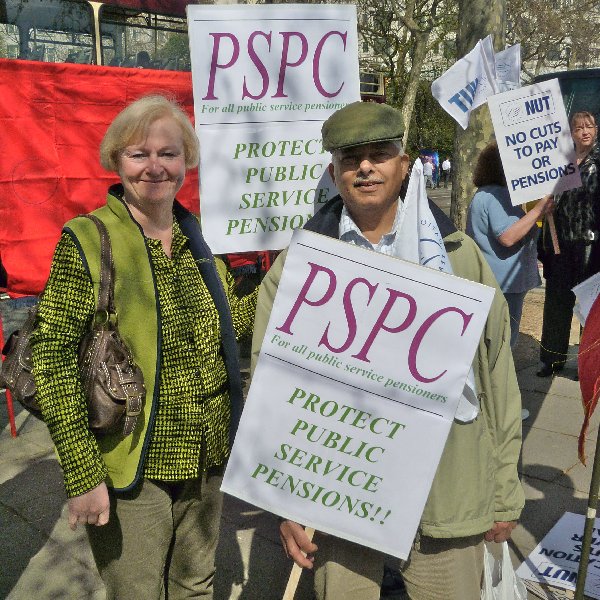

The PSPC took part in the National Pensioners Convention/TUC march and rally, “Defend the welfare state and protect public services”, on 10 April 2010. The event was called to make it clear to any incoming government that welfare and public services must not be subject to further cuts and privatisation. Pictures from the day are in our photo gallery.
PSPC Manifesto Conference
The pension spokespersons from the three main political parties attended PSPC’s General Election conference in March 2010 to discuss their proposals for public sector and state pensions with PSPC representatives. The PSPC launched its manifesto for public sector pensioners at the same event.